

OTC Insights Team
Established in 1963, OTC Industrial Technologies (Ohio Transmission Corporation) is one of the largest industrial distributors & service providers in the United States. We're committed to seeing industrial operations advance through expert technical solutions & unmatched support using our years of experience.
Overview
New-hire safety training is only as good as the equipment it's built on. Lockout tagout training, also called LOTO training, is one of the most heavily regulated parts of industrial onboarding, and it depends on trainers that actually reflect the lockout tagout devices and lockout tagout equipment employees will encounter on the job. When a battery manufacturing plant in Liberty, North Carolina needed to modernize how it trains new employees on lockout tagout procedures, its existing training unit no longer reflected the technology used on its actual production floor. They reached out to OTC Industrial Technologies for their expert support. OTC's engineering team designed and built a new lockout/tagout trainer from the ground up, with no drawings or electrical schematics to work from.
-
Customer - Battery manufacturing plant (Liberty, North Carolina)
-
Relationship Length - Multi-decade partner with an active, ongoing collaboration
The plant relies on lockout/tagout training as a core part of onboarding new employees, since LOTO procedures are one of the most heavily cited safety requirements in industrial workplaces. Its existing training machine was outdated and no longer matched the controls, sensors, and safety technology used in its current manufacturing process.
Challenges
The plant's lockout tagout training equipment had fallen behind the technology actually in use on its production floor, meaning new employees were learning lockout tagout procedures on equipment that didn't reflect real working conditions. The plant needed new LOTO equipment built around current controls and safety technology, including updated controls, a safety curtain, sensors, guards, and pneumatics that were simple for trainees to operate.
The engineering challenge for OTC was significant: there were no drawings or electrical schematics for the existing unit to work from only a physical sample machine to study. OTC's engineering team had to document every component and reverse-engineer the trainer's design before building a modernized replacement.
The plant needed a solution that would:
-
Reflect the controls, sensors, and safety technology actually used in the plant's current manufacturing process
-
Include a safety curtain, guards, and pneumatics that were straightforward for new employees to operate during training
-
Be designed and built without existing drawings or electrical schematics to reference
-
Be delivered on a defined timeline and budget the plant's engineering team could approve upfront
Solution
OTC's engineering team began by reviewing the plant's existing trainer in detail, documenting every component and piece of technology before presenting a budgetary proposal for the plant's engineering group to review.
To deliver the finished trainer, OTC's team:
-
Documented the existing trainer's components and technology with no drawings or schematics to start from
-
Presented a budgetary proposal, followed by a formal quote once the plant's engineering team approved the initial scope
-
Held a series of design meetings to work through power source, pneumatic technology, and safety curtain placement, height, and length
-
Refined multiple features throughout the build process based on the plant's feedback
-
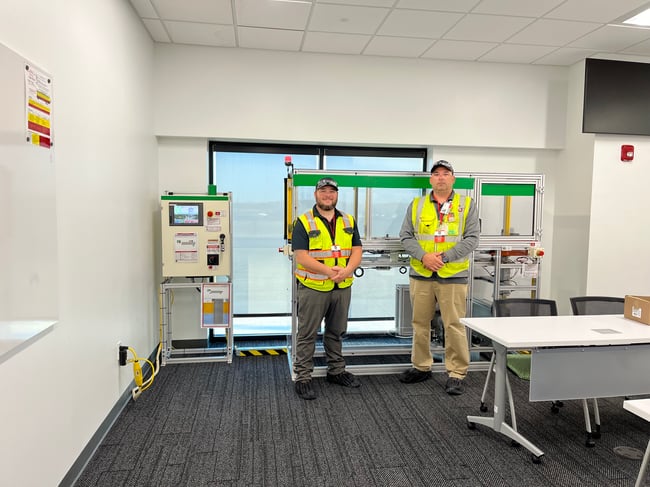
Delivered a complete, up-to-date lockout/tagout trainer built around new controls, sensors, guards, and pneumatics
The finished trainer was delivered within the plant's requested timeline and stayed within the proposed budget. The plant's engineering team trusted OTC's recommendations throughout the design process, even as the scope evolved to fine-tune power, pneumatics, and safety curtain configuration.
Results
Since delivery, the plant has used the new lockout/tagout trainer to train new employees on current, up-to-date safety procedures. Key outcomes include:
-
A fully functioning trainer built to current plant technology, with no reported issues since delivery
-
New-hire LOTO training that now reflects the actual controls and equipment used on the production floor
-
On-time delivery within the plant's requested timeline
-
A finished project that stayed within the approved budget
-
Continued trust in OTC's engineering recommendations throughout a complex, reference-free design process
Conclusion
This case study shows what's possible when a manufacturing plant needs custom safety training equipment but has no existing documentation to build from. OTC's engineering team reverse-engineered a fully functioning lockout/tagout trainer from a single reference sample, then refined the design collaboratively with the plant's team to match its real-world controls and safety technology.
For manufacturers whose lockout/tagout training equipment no longer reflects their current production technology, outdated trainers create a real gap between what new employees learn and what they'll actually encounter on the floor. OTC's automation and engineering teams design and build custom training systems that close that gap — even without original drawings or schematics to start from.
If your facility's safety training equipment hasn't kept pace with your production technology, OTC's engineering team can help design a solution built around your current controls, sensors, and safety systems.
Need Custom Safety Training Equipment?
Contact OTC today to learn how our engineering team can design and build custom lockout/tagout training equipment tailored to your facility's controls and safety systems.